Join Our Newsletter

  • This field is for validation purposes and should be left unchanged.

4-H Family STEM Day Features Robots and Pollinators

4-H ALAMR Robotics

Members of the 4-H ALARM Robotics club prep Siren, their robot, before the start of 4-H Family STEM Day.

On a bright, chilly Saturday in late October, more than 50 prospective and returning 4-H’ers and their parents/guardians gathered at the Mount Ida Campus of UMass Amherst in Newton for the inaugural 4-H Family STEM Day. Listening to 4-H Educators, youths eagerly crowded around a large robot, clamoring for a chance to “hand” their new mechanical friend a white cone.

The event, which was sponsored by MathWorks and was a joint effort between the Massachusetts 4-H program and the Massachusetts 4-H Foundation, featured not only the robot, but also speakers, demonstrations, and hands-on workshops for ages 5-12.

Both the 4-H ALARM Robotics and Ashland Innovation 4-H clubs delivered presentations on their robot design process and machine learning, respectively. The morning also featured a youth presentation on pollinators and how to help them flourish, a presentation also delivered at the Ignite for 4-H Summit in conjunction with the Corteva Agriscience Grows Pollinator Habitat program. These youths hope to expand pollinator gardens to local high schools.

After the presentations, participants had the opportunity to “meet” Siren, a 130-pound robot designed by 4-H ALARM Robotics. They gave the robot a cone and watched it raise the object to a height specified by voice commands.
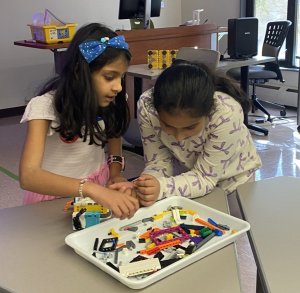
Two girls work on creating a robot at 4-H Family STEM Day.

Two girls work on creating a robot at 4-H Family STEM Day.

Following their time with Siren, the day moved to hands-on workshops. Children aged 8+ worked in teams to build their own miniature robots and then raced them! In another room, youths constructed paper circuits. Cloverbuds aged 5-7 learned about electricity from Kim Pond, 4-H Military and S.E.T. Liaison who designed the 4-H STEM Day program. In the afternoon, attendees had the opportunity to launch bottle rockets and engage in engineering with hydraulics. Cloverbuds tried out Ozobots, which helped them learn coding.

Dhatri Daggubati, a member of 4-H ALARM Robotics who taught a 3D Design workshop for youths 8+, enjoyed the day. “Our team had a wonderful time participating in 4-H STEM Day. The kids were highly engaged, asked great questions, and were very interested in learning more about robotics and STEM,” said Daggubati. “Thanks to you all, we had the opportunity to share our work, bringing it to the next generation of STEM students, sparking a new hobby that the kids could take interest in for a potential lifelong career.”

Throughout the day, teens from 4-H ALARM Robotics and Ashland Innovation 4-H clubs helped younger youth with activities. 4-H STEM Day made science and technology  accessible to youths of all ages and generated interest in Massachusetts 4-H club participation. Thank you to MathWorks for sponsoring this event!


Massachusetts 4-H and UMass Dining Work Together to Feed Students

Zoey Violette is pictured with an award-winning steer.

The positive relationship between University of Massachusetts Amherst’s 4-H Youth Development program and UMass Dining Services has flourished for seven years now. Since 2018, UMass Dining Services has purchased steers raised by Massachusetts 4-H’ers at The Big E’s auction each fall, bringing the process full-circle and putting cash in the pockets of Massachusetts 4-H’ers.

In 2024, thirteen 4-H’ers raised steers for The Big E. The process begins each February when the
4-Hers commit to The Big E, explained Andrew Samuelson, the Animal Science Specialist for Massachusetts 4-H. “The 4-H’ers feed them grain and hay every day, water them daily, put them into pasture, and monitor their growth,” said Andrew.  The steers must weigh at least 900 pounds to be eligible for the auction.

Leading up to the auction, 4-H’ers practice the business side of raising steers by marketing their cattle, said Andrew. “They create a flyer to distribute to potential buyers before the sale,” explained Andrew. “They also talk to potential buyers ahead of time and answer questions about their steer.”

Zoey Violette, a 17-year-old from Sutton, has learned firsthand about raising steers. She sold two steers at The Big E in 2024 and plans to sell two more in 2025. A senior at Blackstone Valley Regional Technical High School, Zoey prepares for The Big E by showing the steers in earlier contests like the Worcester County 4-H Fair.  At the fair, 4-H’ers answer questions about their breeds, judge mock competitions, and try their hand at an old-fashioned beef cookoff.

Zoey’s hard work has paid off. In 2024, she sold two steers: one sized 1,230 pounds at $9/pound and a 1,165-pounder at $5.50/pound. Zoey values all the animal science knowledge she has gained by raising beef throughout her eight years in 4-H. “I think it’s a really great experience,” she said. “You learn so much from it: budgeting, raising an animal. It’s about building the bond with the animal but also learning their purpose. I’ve been lucky with the prices I’ve gotten [at The Big E], and I’m very grateful.” Zoey hopes to continue her education in the Animal Science Department at UMass Amherst.

4-H’er Zoey Violette proudly shows her steer, Zion, purchased by members of UMass Dining Services in 2024. Eugene Cassidy of The Big E is pictured third from left in the red tie.

UMass Dining Services aims to purchase three to four steers per year from 4-Hers to further their goals of serving local, sustainable food and backing 4-H’ers. “We recognize the hard work and effort of 4-Hers who have beef projects,” said Garett Distefano, Director of Dining Services at UMass Amherst. Through their relationship with 4-Hers at The Big E, Dining Services introduces the youth to UMass Amherst as an option for college, Distefano explained.

Long after The Big E is held, the larger lessons endure longer than the steers’ sale proceeds for
4-Hers. “This is such a life lesson for kids,” Andrew said. “They know the animal will be harvested, and they’ve put their heart and soul into the animal. It is one of the most difficult but most beautiful things you will see a 4-H’er do.”


A Hangout for Hounds and their Handlers

Plymouth 4-H Dog Clubs Get a Home at the Marshfield Fair

Ben and Zoe Norris work on preparing the dog area for the 2024 Marshfield Fair.

Until August 2024, the Plymouth County 4-H dog program had no “home” at the Marshfield Fair. At the conclusion of fair dog shows, 4-H’ers and dogs alike had to disperse due to a lack of dedicated space for four-legged friends. Cathy Acampora, Plymouth County 4-H Educator and Massachusetts 4-H Dog Project Coordinator, was determined to make a change and introduce a dedicated area where dogs, 4-H members, and 4-H leaders could stay and visit in between dog events.

Cathy, leader of the A Round of A-Paws Dog Club, found the perfect champion for her plan in the Massachusetts 4-H Foundation and its new Pilot Grant Program. In April 2024, Cathy applied for and was awarded a BOOST (Building Opportunities and Organizational Strength Together) grant of $1,000, which benefited the county’s 4-H dog clubs, including: A Round of A-Paws, Satucket River 4-H Dog Club, Cave Canem, and Bog Dogs.

After receiving the grant, the clubs constructed a dedicated area for the dogs and their young handlers to stay between fair events.  Grant funds were also used to create educational signs about the 4-H dog program, dog safety, and dog breeds to use at the fair and other events.

The 4-H dog clubs then constructed an interactive booth for Marshfield Fair attendees to ask questions of “Bella, the talking dog!”  A 4-H’er wore the Bella mask in the booth during the fair and another answered questions from the public. “The public just loved it. It was fun and engaging,” said Christine Hoyt, leader of the Satucket River 4-H Dog Club of Plymouth/East Middleboro. Even one of the furry friends was spellbound by Bella!

Preparing the new dog area ahead of the Marshfield Fair took time. The clubs needed to remove debris from the area, clean and disinfect it, and remove wire caging. 4-H members helped install foam mats, said Sarah Norris, a parent of a Satucket River 4-H Dog Club member.

Christine Hoyt, leader of the Satucket River 4-H Dog Club, is pictured with Holly the dog and Bella, the talking dog (in booth).The new dog display positively impacted the youth in dog clubs. “It was a hit,” said Cathy. “My goal was to give the dog kids a place at the fair.” Sarah noticed that the 4-H youth from the dog clubs felt more a part of the events. “It allowed the dog kids to be more involved in the fair itself,” she said.

Cathy also had another goal in building the dog display. “I also wanted to integrate the livestock kids with our dog clubs,” she said. “So many of the livestock kids wanted to be Bella, the talking dog!”  The new dog area resulted in the 4-H dog club youth getting to know their livestock counterparts, and Cathy noted there was never similar interaction during past years at the fair.

The dog area’s influence far outlasted the fair days. Hundreds of fairgoers took 4-H flyers at both the Marshfield Fair and The Big E. The Plymouth County 4-H Fair attracted 25 new 4-H members, at least ten of which were interested in dog clubs. As a result, the four dog clubs are now filled, according to Cathy.

The fair dog area has led to a more vibrant, visible 4-H dog program. Most importantly, the new area produced relationships between 4-H youth that might not otherwise have formed. “It was a beautiful experience for everyone,” said Cathy.

4-H’er Max Kendall: Budding Entrepreneur

Most 14-year-olds spend their time after school playing soccer or video games. 4-H’er Max Kendall of Medway, however, has spent his free time inventing a device called Tiny4FSK, a high-altitude, data-transmitting computer that flies on balloons and rockets. Max presented his invention at the Massachusetts 4-H Foundation’s 2024 Annual Meeting to the amazement of those in attendance.

An eighth grader at the Benjamin Franklin Classical Charter School, Max created Tiny4FSK on a printed circuit board. “It is designed to be as lightweight and efficient as possible,” explained Max. “It’s also designed to allow easy access to upper air environments. It can be modified to take pictures.

Tiny4FSK’s true value lies in the data it generates, which it sends back to the ground. “Its main function is tracking, with GPS tracking,” said Max. In addition, the device monitors time, altitude, temperature, pressure, and humidity. ” Tiny4FSK is still in the research and development phase.

Max’s interest in electronics generated a spark that led him to invent Tiny4FSK. After Max received a party balloon as a gift, he purchased a high-altitude balloon. The ease with which he lost the standard balloon reinforced the need to monitor its location. He then began radio tracking and designed a new high-altitude tracking system, which used a protocol called Automatic Packet Reporting System (APRS). Today, Tiny4FSK traces its path via a radio protocol called Horus Binary V2. All of its electronics are built into one board, resulting in a smaller device size.  Max noted he could not have invented Tiny4FSK without the help he received from the New England Weather Balloon Society, of which Max and his father are founders.

Max also cited New England Sci-Tech, (https://nescitech.org), a non-profit STEM education center for youth and families. Max took advantage of its makerspace filled with specialized equipment to build Tiny4FSK. Today, Max pays it forward by volunteering at New England Sci-Tech.

Max has shown his invention at The Big E’s Visual Presentations. He also plans to submit Tiny4FSK to both his school and regional science fairs.

A member of the Science Explorers 4-H Club of Medway, Max leads and mentors in monthly “STEAM (Science/Technology/Engineering/Arts/Math) Tuesdays” with the club at the Medway Public Library.  Recent meeting topics have included volcanoes and black holes.

As for his future, Max has a definite goal. “I hope to be an entrepreneur,” he said excitedly. “I’ve listed my products on a business I’m building.” The business, called Habtronics, will sell ballooning and other high-altitude products, including Tiny4FSK.

Fly high, Max!

Acton C.R.A.F.T. 4-H Club Recycles for Community Service

Club Leader Elaine Shirron and Andy work on a cross stitch project.

Local recycling helps the environment, but for Acton 4-H’ers, it also propels community service! For seven years, the Acton C.R.A.F.T. 4-H Club has been recycling personal products like toothbrushes to fund their successful community service projects. Since 2019, the 4-H’ers have recycled a whopping 2,064 pounds of items, raising $1,370 for community service work.

The project began when Club Co-Leader Margaret Gibbs learned she could salvage products like toothpaste tubes, toothbrushes, hairbrushes, and hair dryers through a company called TerraCycle. TerraCycle gives points for cash according to the number of pounds recycled. “I thought it was a really cool idea,” Margaret said.

Margaret started the recycling initiative by speaking with town officials, the local library, and the school district to generate interest. She then had recycling receptacles placed at Donelan’s Supermarkets in Acton and Littleton, the Reuben Hoar Library in Littleton, and the town transfer station. The club’s proceeds from recycling go toward community service projects and eliminate the need for a specific club fee for each youth.

For several years, the club did food drives at supermarkets in support of local food pantries. Rachel Shirron, another club co-leader, explained that they had the food drive process down to a science. “As people walked in [to the market], they were given a list of what the food pantry wants,” explained Rachel. “Then, they delivered the goods on the way out.” These drives raised 600-800 pounds of food per store four times each year.

Addison and Acton C.R.A.F.T. 4-H Club Leader, Elaine Shirron, work on a baking project together.

Club members have donated tied fleece blankets to the homeless, written letters to frontline workers during the COVID years, and made bracelets for military members. The club has also made meals for those in need. Last year, the club gathered plastic Easter eggs -to the tune of 20 dozen – and filled them with candy to give to their neighbors. This year, they plan to fill plastic eggs again but deliver them to food pantries.

Elaine Shirron has led the club for 30 years. Its membership has varied from three to twelve 4-H’ers, with a current size of three . The club’s small size makes its achievements even more impressive.

The Acton C.R.A.F.T. 4-H Club meets every week, focusing on community service.  “Every single 4-H’er needs to do a community service project. Then they can do other projects,” explained Elaine. Other projects center around leadership skills and Visual Presentations. Most recently, club members have been learning the ukelele!

While the 4-H’ers have learned how to make dinners and run a sewing machine, the true lessons they have gleaned from their projects are about people. By working successfully with others and giving to those less fortunate, the Acton C.R.A.F.T. 4-H Club truly embodies the words “community service.”

Take Action for 4-H Youth in 2025

Margaret Turpel

In 2023, Margaret Turpel. a 4-H’er from Essex County, gathered research and reached out to her representatives to file a bill to put 4-H on equal footing with school sports and clubs. This bill has been recently resubmitted by both the Massachusetts Senate and House. 

If this bill is passed into law, 4-H students will have the same consideration that student-athletes and club members get when absent for school-authorized activities such as games and field trips. We are asking you to contact your state representatives and senators to be aware of the bill and to sign on as cosponsors. Keep reading to learn how you can take action now.

Why is this important? 

Share your story!  4-H provides both local and national opportunities. It is a research-based experience that includes mentors, self-guided activities, and meaningful leadership opportunities. In 4‑H, youth complete hands-on projects in areas like animal science, STEM, agriculture, and civic engagement in a positive environment where they receive guidance from adult mentors and are encouraged to take on leadership roles. Children and youth experience 4‑H in every county and community in Massachusetts through in-school and after-school programs and clubs.

Take Action 

The most important outreach for this legislation will come from 4-H youth to their state representatives and senators. Exercise your ability to advocate and understand the legislative process. The best approach is for youth to personalize the draft letter below and share their projects, career development skills, and knowledge gained from the Massachusetts 4-H program.  

Connect! 

To connect with your State Senate and House Representatives click through the link below and type in your home address: https://malegislature.gov/Search/FindMyLegislator.   

Also connect with the State Senate and House Representatives that are on the Joint Committee on Education: https://malegislature.gov/Committees/Detail/J14/192 

You can use this draft language for your email or letter and add your own 4-H experience to your Senator or Representative:  

Dear Senator or Representative ________, 

I am contacting you to request that you cosponsor House Docket 719 filed by Kenneth P. Sweezey – Plymouth District 6 or Senate Docket 510 submitted by Patrick O’Connor – First Plymouth and Norfolk.  

If passed, this bill would give students participating in 4-H the same consideration that student-athletes and school club members get when absent for school-authorized activities such as games and field trips. 

Share 1-2 sentences about how the 4-H program has made an impact on you. You can also use some of the information below and edit it to share about the 4-H program.

Your support is important to me and the success of the 4-H program! Youth who participate in 4-H are provided incredible opportunities to put their education in action by participating in local and national trips like National 4-H Conference held annually in Washington, D.C., National 4-H Congress held annually in Atlanta, GA, Ignite Summit held annually in Washington D.C., National 4-H Horse Round Up, 4-H Agriculture Day at the Massachusetts State House, the Eastern States Exposition where they showcase their projects, and so much more.

Thank you! I appreciate your support.

Sincerely, 

… 

The Sky is the Limit for 4-H Alarm Robotics

4-H Alarm Robotics wins Engineering Inspiration Award.

The 4-H Alarm Robotics team has enjoyed a successful 2024 – and the year isn’t over yet! Back in early April, the robotics team, based in Franklin, MA, participated in the New England District Championships for the first time, winning the Engineering Inspiration Award and earning a spot at the World Championships held in Houston, TX.

Founded in 2007, 4-H Alarm Robotics is a regional team comprised of 8th -12th grade youth from 11 different towns that participates in the For Inspiration and Recognition of Science and Technology (F.I.R.S.T.) Robotics Program. Stephen Dunbar has led the club since 2016, when he started helping the youth with robot prototypes. The club finds new members via referrals and social media, though many of the current members started as children in another robotics division.

The 4-H Alarm Robotics Club achieved its latest success with a 120-pound robot named HYDRA, which the youth programmed to pick up and shoot objects into a target area. HYDRA is comprised of four modules, each of which has two motors. The youth also installed a swerve drive in HYDRA, which allows it to rotate.

Creating a robot like HYDRA takes weeks of the youths’ time and involves computer-aided design (CAD), programming, and machining.  Each season the team designs a robot , the theme of which is announced each January by F.I.R.S.T.

To kick off the build process, the youth discuss team strategy and concepts for the robot.  Then, the youth break up into teams, creating a CAD model of the future robot. After that, they begin the work of building the robot; the “build season” lasts for six weeks. 4-H Alarm Robotics requires a significant commitment during this phase. While building the robot, team members meet six days per week, including  six hours on Saturdays.

The youth meet at the Red Brick Schoolhouse in Franklin, a historic schoolhouse that is one of the oldest one-room schoolhouses in the country. In 2019, the town issued a notice asking for renters, and 4-H Alarm Robotics expressed interest.

The real work begins with the competitions. The team began at the local level this year, then qualified for the New England District Championships and finally the world competition in Houston. During a competition, the teams create alliances composed of three teams, which in turn compete against other alliances. Despite all the preparation, things don’t always go according to plan. Sometimes the robot’s parts break, so the team always brings along extra. “These kids learn very quickly how to think under pressure,” said Stephen. “They collaborate better than many professionals do.”

In the “off-season,” the team focuses on outreach and developing the skills of children who may become future team members. 4-H ALARM Robotics hosted a robotics competition for middle school-aged youth called the Stephen Green FLL Explore Showcase on April 27 at the Franklin Public Library.  They also coached two teams associated with the Showcase over twelve weeks.

4-H ALARM Robotics also challenged the children to work on a Halloween project called Scratch Hackathon in October 2023.  “My favorite part of the club is outreach,” said Ishika. “You make an impact. I’m teaching kids all the things I’ve learned.”

Apart from outreach, the 4-H Alarm Robotics members appreciate everything they have learned, including lessons they can apply outside of the Red Brick Schoolhouse. “Robotics helps me think in a different way,” said Sri, 14. “In competition, each team is trying to achieve the same tasks, but each in a different way. You can have multiple ways to do the same thing.”

Meeting other youth who share their interest is a bonus too. “One of my favorite things is meeting people,” said Richaa,15. “We try to connect outside of competitions.”

The club was awarded a $3,000 grant in June by the Foundation’s Pilot Grant Program to purchase robot parts, including swerve modules, encoders, motors, and gears.

4-H ALARM Robotics has big plans for the future. “We want to do more advanced programming and get the team’s first blue banner [in the competition] next year,” said Aditya, 15. The team also hopes to start a high school team in North Attleboro.


Hilltown Misfits: a 4-H Club on the Move

The Hilltown Misfits 4-H Club has ambitious plans for the future. Back in the spring, this Chesterfield-based club took advantage of the Massachusetts 4-H Foundation’s Pilot Grant Program after learning about it from 4-H Educator, Erica MacLean. The club was awarded $1,450 to further their activities, specifically with working steer.

Faith Everett Bisbee coordinates the working steer part of the club. However, she said the Hilltown Misfits 4-H Club focuses not only on steer, but also on crafts, rabbits, horses, and community service. “It’s been fun and interesting; we learn about different projects,” she said. While there are 20 youth  in the club, about ten participate in activities with the working steer.

The Hilltown Misfits 4-H Club leads a working steer lesson.The steer program centers around workshops that prepare 4-H youth for fairs like The Big E. Hilltown Misfits has an ongoing partnership with Connecticut Whiplash, another working steer group with adult volunteers. In the spring workshop, volunteer Tom Jenkins showed the youth how to hitch oxen to cut down trees in the woods. The 4-H’ers also learned how to plow with draft horses.

In the fall, the club holds a working steer competition, in which the youth compete against adults and are prepped for The Big E. The youth direct the steer leading a cart around obstacles, such as bridges, or back the animals into a barn. “That’s what we spend the bulk of the time doing, obstacle courses,” explained Faith. “We mimic the situation on a farm.”

The youth also participated in a working steer workshop in June in Farmington, Maine, where they practiced showmanship skills. This training paid off. At The Big E in 2023, two youth from the Hilltown Misfits won the Herdsmenship Award, which recognized how the
4-H’ers interacted with the public and worked together.

Owen, 15, is a member of the Hilltown Misfits, and his family owns four steers at their farm in Belchertown. He has enjoyed his experiences with the club. “I like the friends I make and getting to hang out with them at fairs and 4-H meetings.”

Owen leads a working steer during a show as part of the Hilltown Misfits 4-H Club.Owen has shown working steer at The Big E for the last two years. “The Big E is definitely a lot of work,” Owen said. “It’s fun, and it’s good training experience for the cattle.”

The Hilltown Misfits will use the funds from the Pilot Grant Program for current workshop necessities, such as food, workshop fees, judging costs, and ribbons. Faith also is interested in holding more workshops in the future. “I feel the more workshops we hold, the more people will see us out in the community.”

Faith also hopes a portion of the grant funds may be put toward club travel. “I’m always interested in traveling to different places or having teamsters come in,” said Faith. “We have a cooperative relationship with Connecticut and Maine. I’d love to start an annual get-together with them.”

Jonathan Samuelson: Veterinary Pathologist

Jonathan Samuelson veterinary pathologist

When Jonathan Samuelson was growing up in the Massachusetts 4-H program, he thought he might want to work directly with animals. And after several degrees and a great deal of specialized training, he is…sort of. Jonathan currently works as a Veterinary Anatomic Pathologist and a Clinical Assistant Professor at the University of Illinois at Urbana-Champaign. He shared his profession with Massachusetts 4-H’ers as part of the Career Exploration Series earlier this year.

Jonathan grew up in Athol and moved to Charlton in high school. He became involved with Massachusetts 4-H, specifically with the dairy program and the High Hopes 4-H Club. He participated in 4-H for ten years, following other members of his family, including his brother Andrew, who is the current 4-H Animal Science Departmental Assistant.

Jonathan credits Massachusetts 4-H for laying the foundation for his future career. ”4-H Dairy was formative for my love of animals and understanding how to take care of animals. I really enjoyed my friends and the comradery. I also liked the program’s structure”  said Jonathan. “I liked both the people and participating in the 4-H fairs…having 4-H be a part of my youth was great.”
Jonathan initially planned to be a veterinary technician, due to his interest in animals, science, and biology.  life took him along a different path. He worked at a pharmaceutical company that genetically modified goats to produce human proteins in goats’ milk for use in medicine, all while earning his Bachelor’s degree in Veterinary Science at Becker College.

Jonathan then pursued his Doctor of Veterinary Medicine, graduating from Virginia Maryland College of Veterinary Medicine. After his second year of vet school, he attended a pathology conference, which “ignited a fire.”

Jonathan applied for pathology residencies after veterinary school, and did a three-year residency followed by a one-year internship, plus earned a master’s degree in Pathobiology, the mechanisms of disease, from the University of Illinois.

As a veterinary pathologist, Jonathan’s responsibilities are varied. He performs post-mortem examinations (also known as necropsies or autopsies) and examines surgical biopsies. In his examinations, he looks at samples both visually and through a microscope.

Jonathan’s responsibilities alJonathan Samuelson is pictured with his brother and sister.so include instructing veterinary students, interns, residents, and clients about pathology. Teaching ranks among his favorite duties. “You (the pathologist) are explaining things to everyone, because you’re often the only one who can put together the pieces of the entire disease process,” he said.


Whether 4-H’ers’ interests lie in the veterinary profession or the more specialized world of pathology, Jonathan advises hard work and an openness to possibilities. “I think not closing the door to other possibilities is great, because you may find interest in other areas of veterinary medicine” he explained.

Advocating for the pathology profession, Jonathan said that the job market is currently favorable to pathologists, offering the choice of working in academia, a diagnostic laboratory, or industry. He also emphasized the value that new doctors bring to the table. “Someone who is just starting out can see something differently from someone who has been studying and working for 20 years,” Jonathan noted.

Most importantly, Jonathan appreciates the impact veterinary pathologists make, whether training the next generation of pathologists or providing a client with a solution to a problem. “This profession is for those who want to get into animal disease problems and perform the hard work and research to arrive at solutions,” hsaid.

A 4-H Resurgence on Martha’s Vineyard

Leona enjoys spending time with horses.

Despite being an island grounded in agriculture, Martha’s Vineyard had not run 4-H clubs for years.  Judy Vollmer, a former Barnstable County 4-H Educator and former Foundation Trustee, helped the Vineyard resurrect its 4-H program before her retirement in 2019. Molly Vollmer, Judy’s daughter and current Plymouth County Educator, then took over maintaining the Vineyard’s enrollment records.

Then, enter the Martha’s Vineyard Agricultural Society, a nonprofit organization founded in 1859, which stepped in to take over the day-to-day management of the 4-H program, led by the Society’s 4-H and Program Coordinator Lucy Grinnan. The program has kept growing, and as of October 2023, seven 4-H clubs now operate on the Dukes County Island.

The clubs include Winging It, a bird-watching club run by the Sherrif’s Meadow Foundation. Another club, Paint What You See, introduces painting agrarian subjects to 8–12-year-olds. Its members have submitted paintings to the island’s Agricultural Fair.

Other 4-H clubs concentrate on cooking, photography, or livestock, and there is even a club run by the Martha’s Vineyard Museum that focuses on old-fashioned pursuits such as churning butter and making wool. “Having a variety of clubs can showcase that 4-H is a broad umbrella,” said Lucy.

The longest-running club, led by Slough Farm Executive Director Julie Scott, is the Slough Farm Super Silos. Julie first launched the club in fall 2018 as a Cloverbud club focused on farming, cooking, and art. Dormant during the height of COVID, the Super Silos returned in the Fall of 2022 as an animal science club. The ten members learn about sheep, goats, chickens, cows, pigs, and rabbits, with the Slough Farm Foundation owning the animals.

Henry enjoys a goat’s company.

The club holds a farm animal “Meet and Greet” each June as a 4-H fundraiser. Club members have also staffed the hay bale maze at the island’s Harvest Festival. This year, Super Silos members showed animals at the Vineyard’s Agricultural Fair, some for the first time. “We make sure each child gets some time to focus on the animal they’re interested in,” Julie explained.

Leona, age 9 and a 4th grader, has cared for horses and weighed sheep as a member of the Super Silos. She also participated in the Agricultural Fair by feeding and watering the animals, and holding the rabbits, pigs, and lambs for fair visitors to see. “The horses are my favorite,” said Leona. “4-H has taught me about different animals and how to work in the garden.”

Meanwhile, Lucy and Julie are looking ahead. Lucy would like to see more crossover events between clubs and community service projects. They want to recruit more 4-H leaders to support more clubs.

Julie hopes to strengthen the connection that youth have with agriculture. “This is an agricultural place, and we want people to understand where their food comes from,” explained Julie. “I would love to see more 4-H clubs start up.”

Martha’s Vineyard offers a unique environment for youth to explore 4-H, according to both Lucy and Molly. “I don’t think people realize there are 40 farms on Martha’s Vineyard,” remarked Lucy. While the Vineyard is best known for summer vacationers, agriculture has a huge presence on the island, from the annual Agricultural Fair to each island school boasting its own garden. This makes the need for 4-H more crucial. “The Vineyard has a year-round population in need of programming,” said Molly.


Join Our Newsletter

  • This field is for validation purposes and should be left unchanged.